37. Sudoku Solver #
Problem #
Write a program to solve a Sudoku puzzle by filling the empty cells.
A sudoku solution must satisfy all of the following rules:
- Each of the digits
1-9must occur exactly once in each row. - Each of the digits
1-9must occur exactly once in each column. - Each of the the digits
1-9must occur exactly once in each of the 93x3sub-boxes of the grid.
Empty cells are indicated by the character '.'.
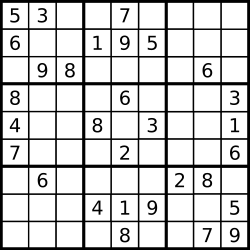
A sudoku puzzle…

…and its solution numbers marked in red.
Note:
- The given board contain only digits
1-9and the character'.'. - You may assume that the given Sudoku puzzle will have a single unique solution.
- The given board size is always
9x9.
Problem Summary #
Write a program to solve a Sudoku puzzle by filling the empty cells. A Sudoku solution must follow the rules below:
- The digits 1-9 can appear only once in each row.
- The digits 1-9 can appear only once in each column.
- The digits 1-9 can appear only once in each 3x3 box separated by thick solid lines.
Empty cells are indicated by ‘.’.
Solution Approach #
- Given a Sudoku puzzle, solve the Sudoku.
- Solution approach: DFS brute-force backtracking enumeration. Sudoku requires that the digits
1-9do not repeat in each row, each column, and each 3x3 box. Each time a number is placed, all 3 of these places need to be checked. - In addition, once one solution is found, there is no need to continue backtracking; just return directly.
Code #
package leetcode

type position struct {
	x int
	y int
}

func solveSudoku(board [][]byte) {
	pos, find := []position{}, false
	for i := 0; i < len(board); i++ {
		for j := 0; j < len(board[0]); j++ {
			if board[i][j] == '.' {
				pos = append(pos, position{x: i, y: j})
			}
		}
	}
	putSudoku(&board, pos, 0, &find)
}

func putSudoku(board *[][]byte, pos []position, index int, succ *bool) {
	if *succ == true {
		return
	}
	if index == len(pos) {
		*succ = true
		return
	}
	for i := 1; i < 10; i++ {
		if checkSudoku(board, pos[index], i) && !*succ {
			(*board)[pos[index].x][pos[index].y] = byte(i) + '0'
			putSudoku(board, pos, index+1, succ)
			if *succ == true {
				return
			}
			(*board)[pos[index].x][pos[index].y] = '.'
		}
	}
}

func checkSudoku(board *[][]byte, pos position, val int) bool {
	// Check whether the row has duplicate numbers
	for i := 0; i < len((*board)[0]); i++ {
		if (*board)[pos.x][i] != '.' && int((*board)[pos.x][i]-'0') == val {
			return false
		}
	}
	// Check whether the column has duplicate numbers
	for i := 0; i < len((*board)); i++ {
		if (*board)[i][pos.y] != '.' && int((*board)[i][pos.y]-'0') == val {
			return false
		}
	}
	// Check whether the 3x3 box has duplicate numbers
	posx, posy := pos.x-pos.x%3, pos.y-pos.y%3
	for i := posx; i < posx+3; i++ {
		for j := posy; j < posy+3; j++ {
			if (*board)[i][j] != '.' && int((*board)[i][j]-'0') == val {
				return false
			}
		}
	}
	return true
}
 中文
中文