237. Delete Node in a Linked List #
Problem #
Write a function to delete a node in a singly-linked list. You will not be given access to the head of the list, instead you will be given access to the node to be deleted directly.
It is guaranteed that the node to be deleted is not a tail node in the list.
Example 1:
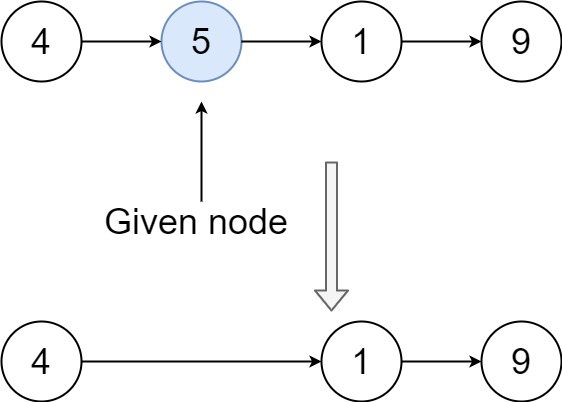
Input: head = [4,5,1,9], node = 5
Output: [4,1,9]
Explanation:You are given the second node with value 5, the linked list should become 4 -> 1 -> 9 after calling your function.
Example 2:
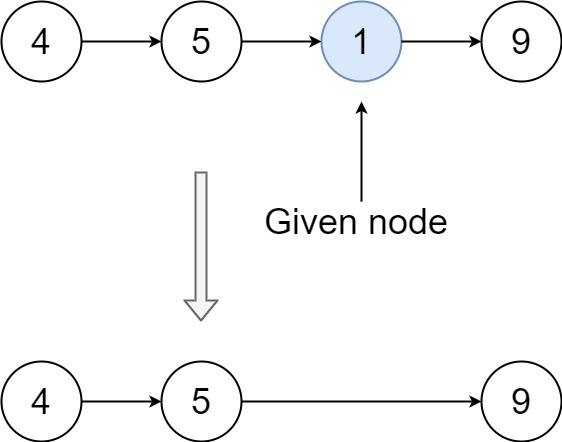
Input: head = [4,5,1,9], node = 1
Output: [4,5,9]
Explanation:You are given the third node with value 1, the linked list should become 4 -> 5 -> 9 after calling your function.
Example 3:
Input: head = [1,2,3,4], node = 3
Output: [1,2,4]
Example 4:
Input: head = [0,1], node = 0
Output: [1]
Example 5:
Input: head = [-3,5,-99], node = -3
Output: [5,-99]
Constraints:
- The number of the nodes in the given list is in the range
[2, 1000]. 1000 <= Node.val <= 1000- The value of each node in the list is unique.
- The
nodeto be deleted is in the list and is not a tail node
Problem Summary #
Delete the given node. The head node of the linked list is not given.
Solution Approach #
Actually, just overwrite it with the following nodes. Or directly set the current node’s value equal to the next node’s value, and point the Next pointer to the node after the next node. This also works, but there will be one intermediate node that is not released, so the memory consumption is slightly higher.
Code #
package leetcode

import (
	"github.com/halfrost/leetcode-go/structures"
)

// ListNode define
type ListNode = structures.ListNode

/**
 * Definition for singly-linked list.
 * type ListNode struct {
 *     Val int
 *     Next *ListNode
 * }
 */
func deleteNode(node *ListNode) {
	node.Val = node.Next.Val
	node.Next = node.Next.Next
}
 中文
中文