543. Diameter of Binary Tree #
Problem #
Given the root of a binary tree, return the length of the diameter of the tree.
The diameter of a binary tree is the length of the longest path between any two nodes in a tree. This path may or may not pass through the root.
The length of a path between two nodes is represented by the number of edges between them.
Example 1:
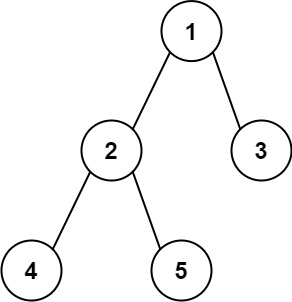
Input: root = [1,2,3,4,5]
Output: 3
Explanation: 3 is the length of the path [4,2,1,3] or [5,2,1,3].
Example 2:
Input: root = [1,2]
Output: 1
Constraints:
- The number of nodes in the tree is in the range
[1, 104]. 100 <= Node.val <= 100
Problem Summary #
Given a binary tree, you need to calculate the length of its diameter. The diameter length of a binary tree is the maximum value among the path lengths between any two nodes. This path may or may not pass through the root node.
Solution Approach #
- Easy problem. Traverse the left subtree and right subtree of each node, and accumulate the maximum length from the left subtree to the right subtree. When traversing each node, dynamically update this maximum length.
Code #
package leetcode

import (
	"github.com/halfrost/leetcode-go/structures"
)

// TreeNode define
type TreeNode = structures.TreeNode

/**
 * Definition for a binary tree node.
 * type TreeNode struct {
 *     Val int
 *     Left *TreeNode
 *     Right *TreeNode
 * }
 */

func diameterOfBinaryTree(root *TreeNode) int {
	result := 0
	checkDiameter(root, &result)
	return result
}

func checkDiameter(root *TreeNode, result *int) int {
	if root == nil {
		return 0
	}
	left := checkDiameter(root.Left, result)
	right := checkDiameter(root.Right, result)
	*result = max(*result, left+right)
	return max(left, right) + 1
}

func max(a int, b int) int {
	if a > b {
		return a
	}
	return b
}
 中文
中文