986. Interval List Intersections #
Problem #
Given two lists of closed intervals, each list of intervals is pairwise disjoint and in sorted order.
Return the intersection of these two interval lists.
(Formally, a closed interval [a, b] (with a <= b) denotes the set of real numbers x with a <= x <= b. The intersection of two closed intervals is a set of real numbers that is either empty, or can be represented as a closed interval. For example, the intersection of [1, 3] and [2, 4] is [2, 3].)
Example 1:
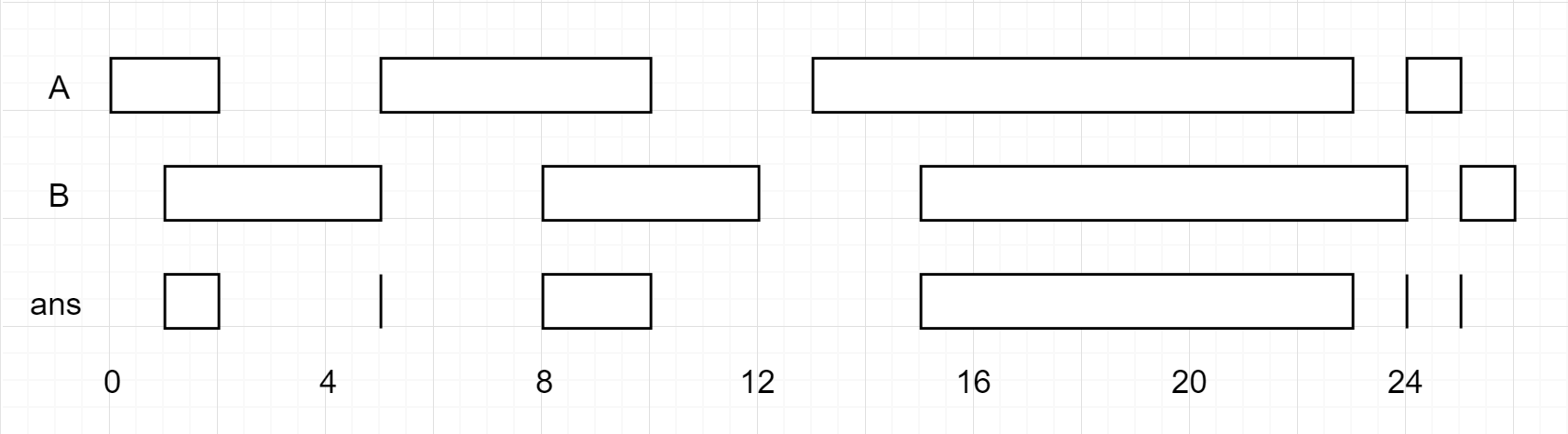
Input: A = [[0,2],[5,10],[13,23],[24,25]], B = [[1,5],[8,12],[15,24],[25,26]]
Output: [[1,2],[5,5],[8,10],[15,23],[24,24],[25,25]]
Reminder: The inputs and the desired output are lists of Interval objects, and not arrays or lists.
Note:
- 0 <= A.length < 1000
- 0 <= B.length < 1000
- 0 <= A[i].start, A[i].end, B[i].start, B[i].end < 10^9
Note: input types have been changed on April 15, 2019. Please reset to default code definition to get new method signature.
Problem Summary #
This problem examines the sliding window technique.
Given two arrays A and B. The task is to find the intersection array of these two arrays. See the figure for the problem statement.
Solution Approach #
The left boundary of the intersection should be start := max(A[i].Start, B[j].Start), and the right boundary should be end := min(A[i].End, B[j].End). If start <= end, then this is a valid intersection and should be added to the final array. If A[i].End <= B[j].End, it means the range of array B is larger than that of array A, so move A’s cursor to the right. If A[i].End > B[j].End, it means the range of array A is larger than that of array B, so move B’s cursor to the right.
Code #
package leetcode

/**
 * Definition for an interval.
 * type Interval struct {
 *	   Start int
 *	   End   int
 * }
 */
func intervalIntersection(A []Interval, B []Interval) []Interval {
	res := []Interval{}
	for i, j := 0, 0; i < len(A) && j < len(B); {
		start := max(A[i].Start, B[j].Start)
		end := min(A[i].End, B[j].End)
		if start <= end {
			res = append(res, Interval{Start: start, End: end})
		}
		if A[i].End <= B[j].End {
			i++
		} else {
			j++
		}
	}
	return res
}
 中文
中文