1235. Maximum Profit in Job Scheduling #
Problem #
We have n jobs, where every job is scheduled to be done from startTime[i] to endTime[i], obtaining a profit of profit[i].
You’re given the startTime , endTime and profit arrays, you need to output the maximum profit you can take such that there are no 2 jobs in the subset with overlapping time range.
If you choose a job that ends at time X you will be able to start another job that starts at time X.
Example 1:
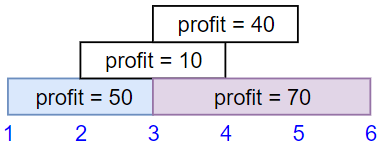
Input: startTime = [1,2,3,3], endTime = [3,4,5,6], profit = [50,10,40,70]
Output: 120
Explanation: The subset chosen is the first and fourth job.
Time range [1-3]+[3-6] , we get profit of 120 = 50 + 70.
Example 2:
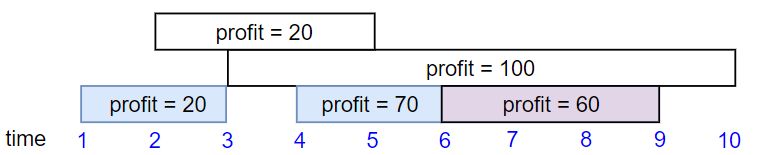
Input: startTime = [1,2,3,4,6], endTime = [3,5,10,6,9], profit = [20,20,100,70,60]
Output: 150
Explanation: The subset chosen is the first, fourth and fifth job.
Profit obtained 150 = 20 + 70 + 60.
Example 3:
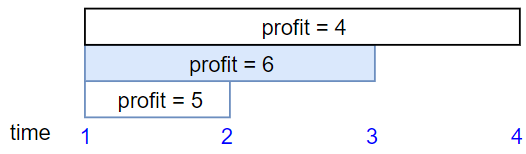
Input: startTime = [1,1,1], endTime = [2,3,4], profit = [5,6,4]
Output: 6
Constraints:
1 <= startTime.length == endTime.length == profit.length <= 5 * 10^41 <= startTime[i] < endTime[i] <= 10^91 <= profit[i] <= 10^4
Problem Summary #
You plan to use your free time to do part-time work and earn some pocket money. There are n part-time jobs here; each job is scheduled to start at startTime[i] and end at endTime[i], with a reward of profit[i]. You are given a part-time job list containing three arrays: start time startTime, end time endTime, and expected reward profit. Please calculate and return the maximum reward you can obtain. Note that 2 jobs whose times overlap cannot be performed at the same time. If a job you choose ends at time X, then you can immediately take the next job that starts at time X.
Constraints:
- 1 <= startTime.length == endTime.length == profit.length <= 5 * 10^4
- 1 <= startTime[i] < endTime[i] <= 10^9
- 1 <= profit[i] <= 10^4
Solution Approach #
- Given a set of tasks, each task has a start time, an end time, and a profit. Once a task starts and has not yet ended, no other tasks can be scheduled in between. How should the tasks be scheduled so that the final profit is maximized?
- For typical task problems or interval problems, you usually consider whether sorting can be applied. For this problem, first sort the tasks by end time in ascending order; if the end times are the same, sort by profit in ascending order.
dp[i]represents the maximum profit obtainable from the firstijobs. The initial value isdp[0] = job[1].profit. For any taski, check whether ajsatisfying the conditionjobs[j].enTime <= jobs[j].startTime && j < ican be found, that is, search forupper_bound. Sincejobshas been sorted, binary search can be used here. If a task j satisfying the condition can be found, then the state transition equation is:dp[i] = max(dp[i-1], jobs[i].profit). If a task j satisfying the condition can be found, then the state transition equation is:dp[i] = max(dp[i-1], dp[low]+jobs[i].profit). The final answer is indp[len(startTime)-1].
Code #
package leetcode

import "sort"

type job struct {
	startTime int
	endTime   int
	profit    int
}

func jobScheduling(startTime []int, endTime []int, profit []int) int {
	jobs, dp := []job{}, make([]int, len(startTime))
	for i := 0; i < len(startTime); i++ {
		jobs = append(jobs, job{startTime: startTime[i], endTime: endTime[i], profit: profit[i]})
	}
	sort.Sort(sortJobs(jobs))
	dp[0] = jobs[0].profit
	for i := 1; i < len(jobs); i++ {
		low, high := 0, i-1
		for low < high {
			mid := low + (high-low)>>1
			if jobs[mid+1].endTime <= jobs[i].startTime {
				low = mid + 1
			} else {
				high = mid
			}
		}
		if jobs[low].endTime <= jobs[i].startTime {
			dp[i] = max(dp[i-1], dp[low]+jobs[i].profit)
		} else {
			dp[i] = max(dp[i-1], jobs[i].profit)
		}
	}
	return dp[len(startTime)-1]
}

type sortJobs []job

func (s sortJobs) Len() int {
	return len(s)
}
func (s sortJobs) Less(i, j int) bool {
	if s[i].endTime == s[j].endTime {
		return s[i].profit < s[j].profit
	}
	return s[i].endTime < s[j].endTime
}
func (s sortJobs) Swap(i, j int) {
	s[i], s[j] = s[j], s[i]
}
 中文
中文