1260. Shift 2D Grid #
Problem #
Given a 2D grid of size m x n and an integer k. You need to shift the grid k times.
In one shift operation:
- Element at
grid[i][j]moves togrid[i][j + 1]. - Element at
grid[i][n - 1]moves togrid[i + 1][0]. - Element at
grid[m - 1][n - 1]moves togrid[0][0].
Return the 2D grid after applying shift operation k times.
Example 1:
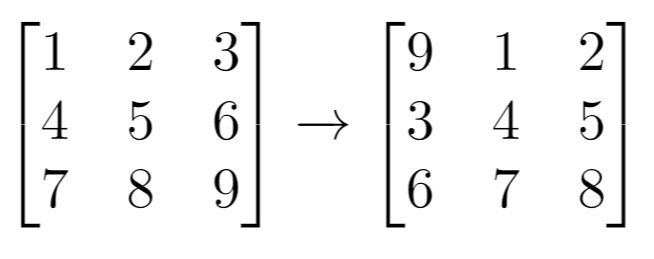
Input: grid = [[1,2,3],[4,5,6],[7,8,9]], k = 1
Output: [[9,1,2],[3,4,5],[6,7,8]]
Example 2:
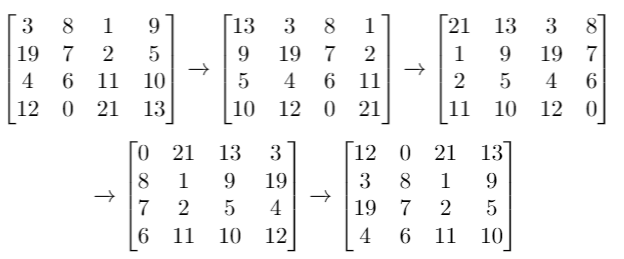
Input: grid = [[3,8,1,9],[19,7,2,5],[4,6,11,10],[12,0,21,13]], k = 4
Output: [[12,0,21,13],[3,8,1,9],[19,7,2,5],[4,6,11,10]]
Example 3:
Input: grid = [[1,2,3],[4,5,6],[7,8,9]], k = 9
Output: [[1,2,3],[4,5,6],[7,8,9]]
Constraints:
m == grid.lengthn == grid[i].length1 <= m <= 501 <= n <= 50-1000 <= grid[i][j] <= 10000 <= k <= 100
Problem Summary #
Given an m-row, n-column 2D grid grid and an integer k. You need to shift grid k times. Each “shift” operation causes the following actions:
- The element at grid[i][j] moves to grid[i][j + 1].
- The element at grid[i][n - 1] moves to grid[i + 1][0].
- The element at grid[m - 1][n - 1] moves to grid[0][0].
Return the final 2D grid obtained after k shift operations.
Solution Approach #
- Given a matrix and a shift count k, move each element in the matrix backward by k steps; the last element moves to the front, forming a cyclic shift, and finally output the matrix after the shift is completed.
- This is an easy problem. Just perform the cyclic shift according to the problem statement, and be careful to handle boundary cases.
Code #
package leetcode

func shiftGrid(grid [][]int, k int) [][]int {
	x, y := len(grid[0]), len(grid)
	newGrid := make([][]int, y)
	for i := 0; i < y; i++ {
		newGrid[i] = make([]int, x)
	}
	for i := 0; i < y; i++ {
		for j := 0; j < x; j++ {
			ny := (k / x) + i
			if (j + (k % x)) >= x {
				ny++
			}
			newGrid[ny%y][(j+(k%x))%x] = grid[i][j]
		}
	}
	return newGrid
}
 中文
中文