1329. Sort the Matrix Diagonally #
Problem #
A matrix diagonal is a diagonal line of cells starting from some cell in either the topmost row or leftmost column and going in the bottom-right direction until reaching the matrix’s end. For example, the matrix diagonal starting from mat[2][0], where mat is a 6 x 3 matrix, includes cells mat[2][0], mat[3][1], and mat[4][2].
Given an m x n matrix mat of integers, sort each matrix diagonal in ascending order and return the resulting matrix.
Example 1:
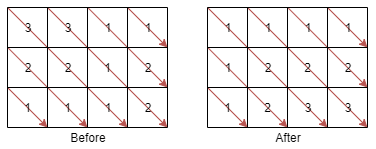
Input: mat = [[3,3,1,1],[2,2,1,2],[1,1,1,2]]
Output: [[1,1,1,1],[1,2,2,2],[1,2,3,3]]
Constraints:
m == mat.lengthn == mat[i].length1 <= m, n <= 1001 <= mat[i][j] <= 100
Problem Summary #
Given an m * n integer matrix mat, sort the elements on each diagonal (from top-left to bottom-right) in ascending order, and return the sorted matrix.
Solution Approach #
- The idea for this problem is very simple. By diagonal, read the elements of each diagonal into an array. Here, a map can be used to store these arrays. Then sort these arrays. Finally, restore the matrix by diagonal.
Code #
package leetcode

func diagonalSort(mat [][]int) [][]int {
	m, n, diagonalsMap := len(mat), len(mat[0]), make(map[int][]int)
	for i := 0; i < m; i++ {
		for j := 0; j < n; j++ {
			diagonalsMap[i-j] = append(diagonalsMap[i-j], mat[i][j])
		}
	}
	for _, v := range diagonalsMap {
		sort.Ints(v)
	}
	for i := 0; i < m; i++ {
		for j := 0; j < n; j++ {
			mat[i][j] = diagonalsMap[i-j][0]
			diagonalsMap[i-j] = diagonalsMap[i-j][1:]
		}
	}
	return mat
}
 中文
中文