1572. Matrix Diagonal Sum #
Problem #
Given a square matrix mat, return the sum of the matrix diagonals.
Only include the sum of all the elements on the primary diagonal and all the elements on the secondary diagonal that are not part of the primary diagonal.
Example 1:
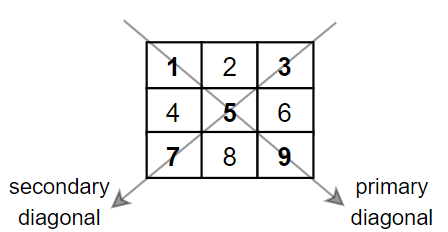
Input: mat = [[1,2,3],
              [4,5,6],
              [7,8,9]]
Output: 25
Explanation:Diagonals sum: 1 + 5 + 9 + 3 + 7 = 25
Notice that element mat[1][1] = 5 is counted only once.
Example 2:
Input: mat = [[1,1,1,1],
              [1,1,1,1],
              [1,1,1,1],
              [1,1,1,1]]
Output: 8
Example 3:
Input: mat = [[5]]
Output: 5
Constraints:
n == mat.length == mat[i].length1 <= n <= 1001 <= mat[i][j] <= 100
Problem Summary #
Given a square matrix mat, return the sum of the matrix diagonal elements. Return the sum of the elements on the primary diagonal and the elements on the secondary diagonal that are not on the primary diagonal.
Solution Approach #
- Easy problem. According to the problem statement, add up the elements on the primary diagonal and the secondary diagonal.
- If the length n of the square matrix is odd, the result of the addition needs to subtract mat[n/2][n/2].
Code #
package leetcode

func diagonalSum(mat [][]int) int {
	n := len(mat)
	ans := 0
	for pi := 0; pi < n; pi++ {
		ans += mat[pi][pi]
	}
	for si, sj := n-1, 0; sj < n; si, sj = si-1, sj+1 {
		ans += mat[si][sj]
	}
	if n%2 == 0 {
		return ans
	}
	return ans - mat[n/2][n/2]
}
 中文
中文