1648. Sell Diminishing-Valued Colored Balls #
Problem #
You have an inventory of different colored balls, and there is a customer that wants orders balls of any color.
The customer weirdly values the colored balls. Each colored ball’s value is the number of balls of that color you currently have in your inventory. For example, if you own 6 yellow balls, the customer would pay 6 for the first yellow ball. After the transaction, there are only 5 yellow balls left, so the next yellow ball is then valued at 5 (i.e., the value of the balls decreases as you sell more to the customer).
You are given an integer array, inventory, where inventory[i] represents the number of balls of the ith color that you initially own. You are also given an integer orders, which represents the total number of balls that the customer wants. You can sell the balls in any order.
Return the maximum total value that you can attain after selling orders colored balls. As the answer may be too large, return it modulo 109 + 7.
Example 1:
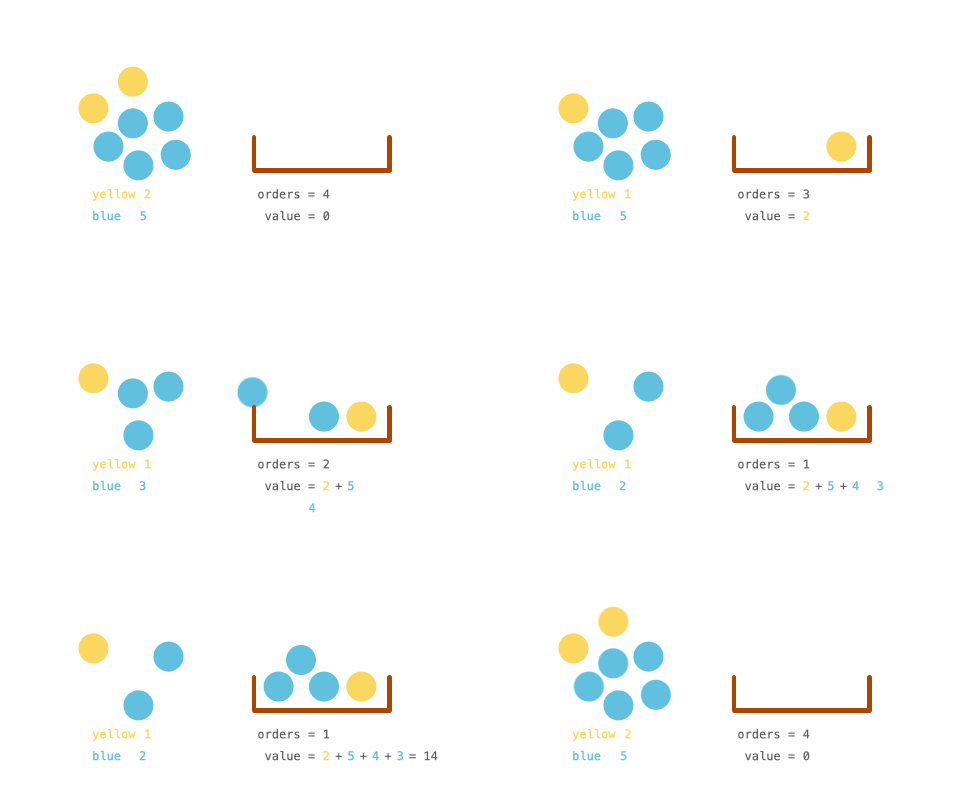
Input: inventory = [2,5], orders = 4
Output: 14
Explanation: Sell the 1st color 1 time (2) and the 2nd color 3 times (5 + 4 + 3).
The maximum total value is 2 + 5 + 4 + 3 = 14.
Example 2:
Input: inventory = [3,5], orders = 6
Output: 19
Explanation: Sell the 1st color 2 times (3 + 2) and the 2nd color 4 times (5 + 4 + 3 + 2).
The maximum total value is 3 + 2 + 5 + 4 + 3 + 2 = 19.
Example 3:
Input: inventory = [2,8,4,10,6], orders = 20
Output: 110
Example 4:
Input: inventory = [1000000000], orders = 1000000000
Output: 21
Explanation: Sell the 1st color 1000000000 times for a total value of 500000000500000000. 500000000500000000 modulo 109 + 7 = 21.
Constraints:
1 <= inventory.length <= 10^51 <= inventory[i] <= 10^91 <= orders <= min(sum(inventory[i]), 10^9)
Problem Summary #
You have an inventory of balls, inventory, containing balls of different colors. A customer wants a total of orders balls of any color. This customer has a special way of valuing the balls: each ball’s value is the current number of remaining balls of the same color. For example, if there are 6 yellow balls left, then when the customer buys the first yellow ball, its value is 6. After this transaction, only 5 yellow balls remain, so the next yellow ball has a value of 5 (that is, the value of balls decreases as the customer buys more balls of the same color).
You are given an integer array inventory, where inventory[i] represents the initial number of balls of the ith color. You are also given an integer orders, which represents the total number of balls the customer wants to buy. You can sell the balls in any order. Return the maximum total value after selling orders balls. Since the answer may be very large, return the result modulo 109 + 7.
Constraints:
- 1 <= inventory.length <= 10^5
- 1 <= inventory[i] <= 10^9
- 1 <= orders <= min(sum(inventory[i]), 10^9)
Solution Thought Process #
Given an
inventoryarray andordersoperations, the task is to output the sum of the largestorderselements in the array. Note that every time an elementinventory[i]is added to the sum, that element decreases by one. The next time we add again, we need to choose the maximum value of the updated array.After seeing this problem, it is easy to think of using a priority queue. Build a max heap,
popthe current maximum valuemaxItem, add it to the result, then decrementmaxItemby one andpushit back. After repeating this looporderstimes, we get the final result. This is indeed what the problem means, but we cannot write the code this way because the constraints give the size oforders. The maximum value of orders is 10^9. This priority queue approach will definitely time out, with a time complexity of O(orders⋅logn). So we need another idea. In the priority queue approach, the operation is repeatedorderstimes, but among these operations, some are unnecessary redundant operations. These numerous “wasted” operations cause the timeout. Consider whether, among theordersoperations, we can mergenpopoperations and firstpopthe topnlargest numbers in one go. This is feasible, because every time an element ispopped, it only decreases by one, which is very regular.To make the following description clearer and easier to understand, we also need to define one more value:
thresholdValue, which is the maximum value of the currentinventoryarray after performing the operationntimes. Regarding the understanding ofthresholdValue, note thatthresholdValuecan come from two sources: one is that the value already exists in the original array, and the other is that aninventory[i]element decreases tothresholdValue. For example: the original array is [2,3,3,4,5], andorders= 4. After taking 4 times, the remaining array is [2,2,3,3,3]. Among the three 3s, one of them comes from4-1=3, or from5-2=3.Use binary search in the interval [0, max(
inventory)] to find thisthresholdValue, the minimumthresholdValuethat satisfies the following inequality: \[ \sum_{inventory[i]\geqslant thresholdValue}^{} \left ( inventory[i] - thresholdValue \right )\leqslant orders \] The smallerthresholdValueis, the larger the value on the left side of the inequality is. AsthresholdValueincreases, the value on the left side becomes smaller and smaller, until it just becomes less than or equal toorders. After findingthresholdValue, we still need to determine how many values are equal tothresholdValue - 1.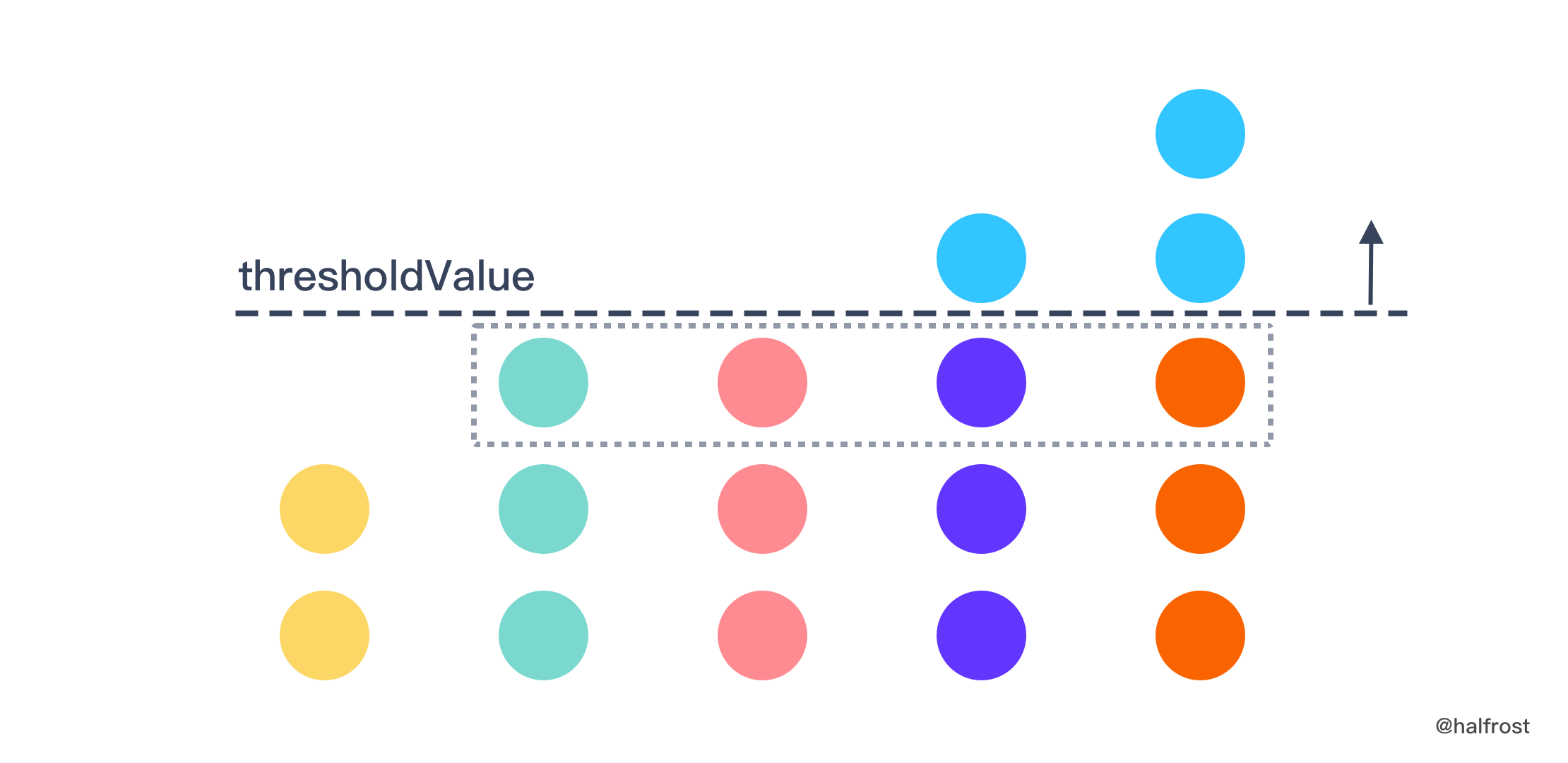
Using the example above again, the original array is [2,3,3,4,5], and
orders= 4. We can obtainthresholdValue= 3. The part whereinventory[i]>thresholdValuemust be taken 100%.thresholdValueis like a water level: everything above the water level must be taken away, and the values in each column can be calculated using the arithmetic sequence sum formula. Butorders-thresholdValue= 1, which means one more ball below the water level needs to be taken, namely one arbitrary ball among the 4 balls inside the dashed box below thethresholdValueline. The final total result is the sum of these 2 parts, ( ( 5 + 4 ) + 4 ) + 3 = 16.
Code #
package leetcode

import (
	"container/heap"
)

// Solution 1 Greedy + Binary Search
func maxProfit(inventory []int, orders int) int {
	maxItem, thresholdValue, count, res, mod := 0, -1, 0, 0, 1000000007
	for i := 0; i < len(inventory); i++ {
		if inventory[i] > maxItem {
			maxItem = inventory[i]
		}
	}
	low, high := 0, maxItem
	for low <= high {
		mid := low + ((high - low) >> 1)
		for i := 0; i < len(inventory); i++ {
			count += max(inventory[i]-mid, 0)
		}
		if count <= orders {
			thresholdValue = mid
			high = mid - 1
		} else {
			low = mid + 1
		}
		count = 0
	}
	count = 0
	for i := 0; i < len(inventory); i++ {
		count += max(inventory[i]-thresholdValue, 0)
	}
	count = orders - count
	for i := 0; i < len(inventory); i++ {
		if inventory[i] >= thresholdValue {
			if count > 0 {
				res += (thresholdValue + inventory[i]) * (inventory[i] - thresholdValue + 1) / 2
				count--
			} else {
				res += (thresholdValue + 1 + inventory[i]) * (inventory[i] - thresholdValue) / 2
			}
		}
	}
	return res % mod
}
 中文
中文