1669. Merge In Between Linked Lists #
Problem #
You are given two linked lists: list1 and list2 of sizes n and m respectively.
Remove list1's nodes from the ath node to the bth node, and put list2 in their place.
The blue edges and nodes in the following figure incidate the result:
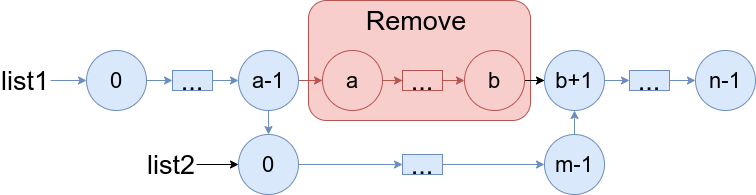
Build the result list and return its head.
Example 1:
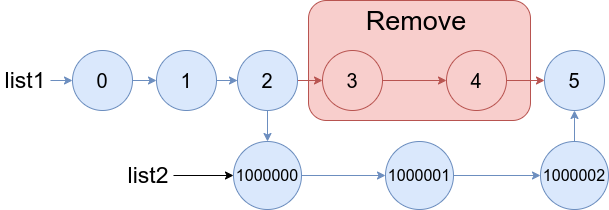
Input: list1 = [0,1,2,3,4,5], a = 3, b = 4, list2 = [1000000,1000001,1000002]
Output: [0,1,2,1000000,1000001,1000002,5]
Explanation: We remove the nodes 3 and 4 and put the entire list2 in their place. The blue edges and nodes in the above figure indicate the result.
Example 2:
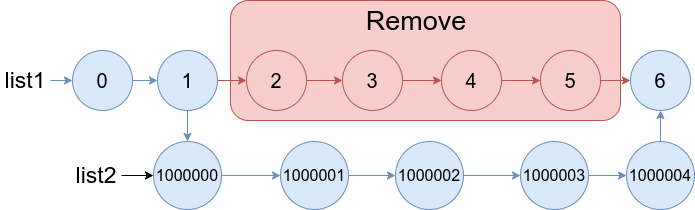
Input: list1 = [0,1,2,3,4,5,6], a = 2, b = 5, list2 = [1000000,1000001,1000002,1000003,1000004]
Output: [0,1,1000000,1000001,1000002,1000003,1000004,6]
Explanation: The blue edges and nodes in the above figure indicate the result.
Constraints:
3 <= list1.length <= 1041 <= a <= b < list1.length - 11 <= list2.length <= 104
Problem Summary #
You are given two linked lists, list1 and list2, containing n and m elements respectively. Delete the nodes from the ath node to the bth node in list1, and connect list2 at the position of the deleted nodes.
Solution Approach #
- An easy problem that tests basic linked list operations. Pay attention to the case where a == b.
Code #
func mergeInBetween(list1 *ListNode, a int, b int, list2 *ListNode) *ListNode {
	n := list1
	var startRef, endRef *ListNode
	for i := 0; i <= b; i++ {
		if i == a-1 {
			startRef = n
		}
		if i == b {
			endRef = n
		}
		n = n.Next
	}
	startRef.Next = list2
	n = list2
	for n.Next != nil {
		n = n.Next
	}
	n.Next = endRef.Next
	return list1
}
 中文
中文